

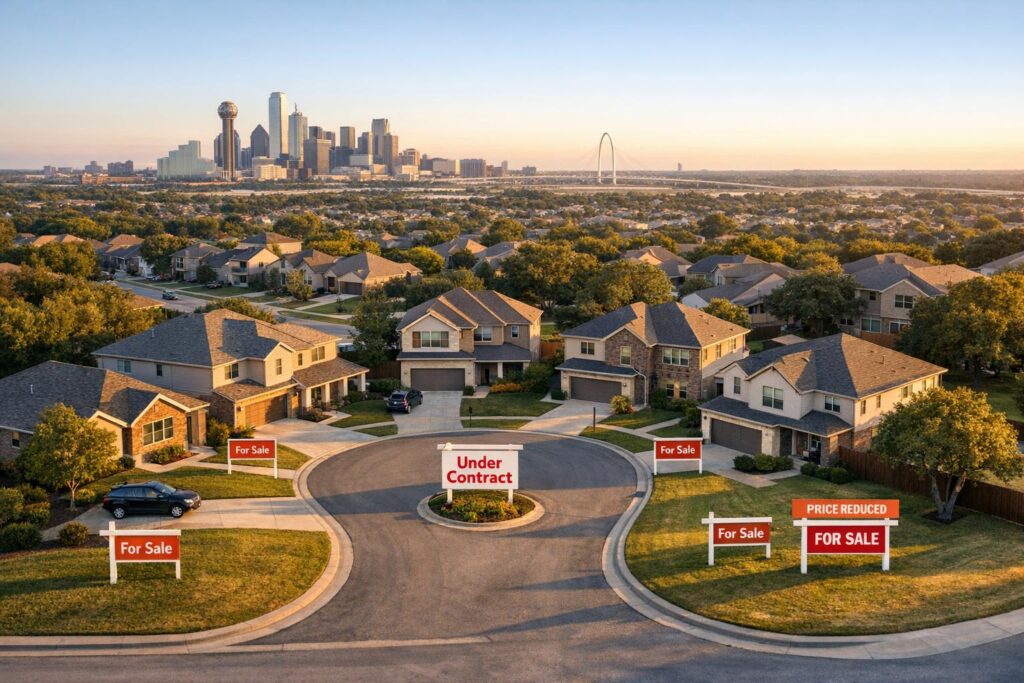
The Dallas-Fort Worth real estate market in 2026 is stabilizing after years of rapid growth. Here’s what you need to know:
- Market Shift: The housing market has transitioned from a seller’s frenzy to a more balanced environment with increased inventory and longer time on the market.
- Prices: Median home prices are expected to grow modestly (1.3%–1.8%), with some suburban areas seeing price dips due to increased supply.
- Mortgage Rates: Rates have settled between 6.0%–6.3%, improving affordability compared to the highs of 2024.
- Buyer Trends: More negotiating power as 21% of listings now see price reductions, and inventory levels have risen to 3.2 months.
- Seller Adjustments: Homes must be priced competitively and well-presented to sell quickly, with buyers requesting more concessions like repair credits.
- Investor Opportunities: Focus on cash flow strategies, with promising areas like Ellis County and the "Westoplex" offering growth potential.
The market is no longer about bidding wars but making informed decisions. Whether you’re buying, selling, or investing, understanding these trends is key to navigating the 2026 DFW housing landscape.
DFW Market Conditions in Early 2026
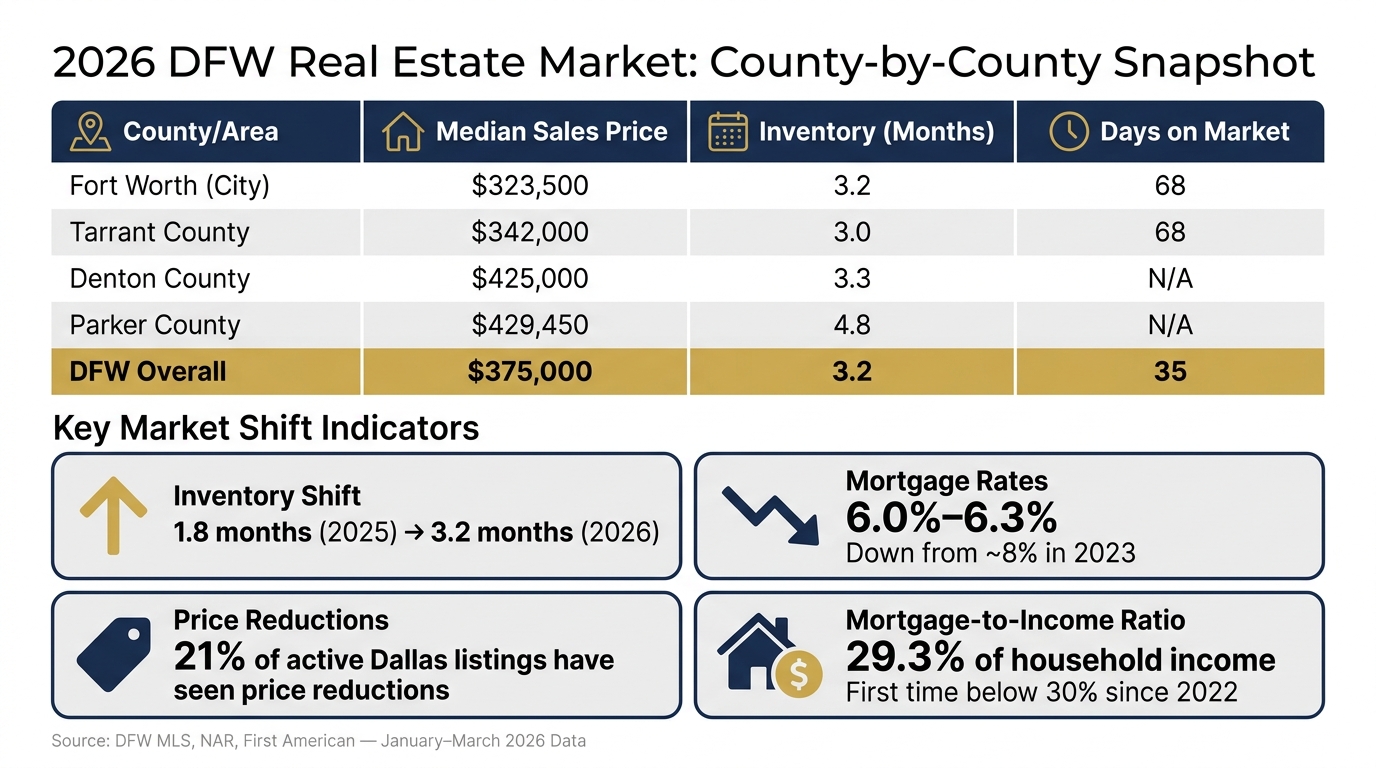
2026 DFW Real Estate Market: County-by-County Snapshot
Key Market Metrics by County
The DFW real estate market is showing signs of cooling compared to its pandemic-era highs, but it hasn’t taken a nosedive. Here’s a snapshot of how the major counties are performing as of January 2026:
| County/Area | Median Sales Price | Inventory (Months) | Days on Market |
|---|---|---|---|
| Fort Worth (City) | $323,500 | 3.2 | 68 |
| Tarrant County | $342,000 | 3.0 | 68 |
| Denton County | $425,000 | 3.3 | N/A |
| Parker County | $429,450 | 4.8 | N/A |
| DFW Overall | $375,000 | 3.2 | 35 |
A few trends stand out. Parker County’s inventory sits at 4.8 months, pointing to a more buyer-friendly environment. Meanwhile, Denton County saw a 4.2% year-over-year dip in prices, largely due to an increase in active listings. Tarrant County, on the other hand, has held steady at $342,000. These variations highlight that local conditions are now playing a bigger role in shaping the market. The result? A shift from the seller-dominated market of previous years to one that’s more balanced.
From a Seller’s Market to a Balanced One
Between 2021 and 2023, buyers were rushing to waive inspections, offer above asking price, and make decisions in record time. By 2025, those frenzied conditions began to normalize, with sellers adjusting their expectations. Now, inventory has risen from 1.8 months in 2025 to 3.2 months, giving buyers the breathing room to negotiate and make more informed decisions.
For sellers who haven’t adjusted, the impact is clear. Shawn Buck, the 2026 GFWAR President, explains:
"The region is currently insulated from extreme price drops due to the popularity and affordability of the area."
This isn’t a market crash – it’s a correction. Homes that are priced appropriately are still selling within two weeks. However, overpriced or poorly maintained properties are lingering on the market, with buyers increasingly requesting closing cost credits and repair allowances.
How Mortgage Rates Are Affecting Affordability
The shift to a more balanced market is being supported by stabilized mortgage rates. Early 2026 has seen rates settle in the 6.0%–6.3% range, a welcome drop from the near-8% highs of late 2023. To put this into perspective, a reduction from 7% to 6% on a $400,000 loan translates to savings of about $263 per month – or $3,156 annually.
For the first time since 2022, mortgage payments are expected to fall below 30% of household income, averaging 29.3%. With wages in DFW growing at around 3.9% annually and home prices increasing at a slower pace of 1%–2.2%, purchasing power is steadily improving. Mark Fleming, Chief Economist at First American, puts it this way:
"For the first time in several years, the underlying forces are finally aligned toward gradual improvement."
If you’re unsure how these rate changes impact your budget, Tom’s Texas Realty offers a handy mortgage qualification tool to help you get a clear picture of your purchasing power – no guesswork involved.
sbb-itb-9bb2e84
2026 DFW Real Estate Market Predictions
Home Price Forecasts by Sub-Region
The DFW housing market is showing notable contrasts. While experts predict a modest rise in median home prices between 1.3% and 1.8% for 2026 overall, this average doesn’t tell the full story – specific areas are experiencing very different trends.
In the northern suburbs, particularly in Collin and Denton counties (including places like Celina and Prosper), prices are taking a hit. Increased new construction has added to the housing supply, leading to a drop of over 3% in resale prices for starter and mid-tier homes. On the other hand, the luxury market (homes priced above $1 million) is thriving, with values climbing approximately 3.5%, as wealthier buyers remain less affected by higher mortgage rates.
Meanwhile, on the southern edge of the metro area, Ellis County is holding steady. Median home prices in towns like Ennis ($295,000) and Midlothian ($385,000) remain far more affordable compared to the $485,000–$525,000+ price tags seen in established Collin County suburbs like Plano and Frisco. These contrasting trends are shaping inventory levels and sales activity across the region.
Projected Inventory and Sales Volume
As of March 2026, DFW listings have climbed to 35,921, marking an increase of 32.1% above pre-pandemic inventory levels statewide. February 2026 data for the DFW-Arlington area highlights some key year-over-year changes:
| Metric (DFW-Arlington) | February 2026 YoY % Change |
|---|---|
| Sales Volume | -6.62% |
| Active Listings | +7.28% |
| Median Close Price | -2.16% |
| Days to Sell | +8.00% |
| New Listings | +5.25% |
For the year as a whole, Texas single-family home sales are expected to grow by 2.5%, reaching around 349,000 units. Additionally, about 21% of active Dallas listings in early 2026 had price reductions, signaling that buyers are gaining more negotiating power than they’ve had in recent years.
How Different Submarkets Will Perform
The performance of DFW’s submarkets in 2026 reflects a clear divide between the urban core and the fast-growing suburbs. Closer-in neighborhoods are maintaining price stability due to limited inventory. However, outer suburbs with substantial new construction are offering buyers more opportunities to negotiate.
One standout growth area is the "Westoplex", which includes Fort Worth and surrounding western counties. This region is benefiting from available land, lower development costs, and increased corporate interest. As Dr. Sriram Villupuram, Associate Professor at UT Arlington, explains:
"The ‘Westoplex’ is emerging as the region’s next major growth frontier… it represents the part of the Metroplex with the most room to grow."
For condo and townhome owners, pricing aggressively is becoming critical, as these segments are underperforming compared to the broader market.
These trends provide valuable insights for buyers, sellers, and investors looking to navigate the evolving real estate landscape in DFW.
What Buyers, Sellers, and Investors Should Do in 2026
How to Buy a Home in 2026
The current balanced market gives buyers more room to negotiate. With 3.2–5 months of inventory and 21% of listings seeing price reductions, the landscape has shifted from the seller-friendly conditions of recent years.
Target homes that have been on the market longer than the local average of 35 to 73 days. Sellers of these properties are often more open to offering concessions, such as seller-paid 2/1 rate buydowns, inspection repair credits, or closing cost assistance. These incentives can help lower your monthly expenses more effectively than a simple price reduction.
It’s also worth comparing new construction to resale homes. For example, builders in areas like Celina and Prosper are offering incentives ranging from $20,000 to $40,000. For older homes, factor in the cost of a foundation report, which typically runs between $400 and $600.
If you’re serious about buying, make sure to get a fully underwritten pre-approval, especially in competitive areas with high-demand school districts. Tom’s Texas Realty provides a free home buying guide that walks you through the lending process, neighborhood selection, and even gives access to off-market listings – offering up to three times more options than what’s available on the MLS.
"The DFW market in 2026 rewards buyers who understand the nuances – and sellers who price for the market that exists, not the one they remember." – Unlocking DFW
How to Sell a Home When the Market Has Slowed
Selling in 2026 requires a different approach. Successful sellers are pricing their homes based on the most recent 30–60 days of comparable sales, rather than relying on outdated market conditions. With active listings in the DFW area hitting 33,593 in February 2026 – a year-over-year increase of 11% – buyers are becoming much more selective.
"The days of pricing high and getting it anyway are over. Homes priced 5–10% above market value sit unsold while fairly-priced homes receive offers quickly." – Stromation Homes Team
Presentation matters just as much as pricing. Move-in-ready homes consistently attract more interest than those needing work. Sellers should invest in deep cleaning, neutral paint, professional photography, and landscaping to make their homes shine. Offering $5,000–$15,000 in closing cost assistance has also proven effective in moving slower listings.
Be ready for inspection negotiations, as buyers are no longer waiving inspection contingencies. Requests for repair credits or home warranties (costing $600–$900) are becoming common. For help refining your pricing, marketing, and contract strategies, check out Tom’s Texas Realty’s free home selling guide.
Investing in DFW Real Estate in 2026
Investors are shifting their focus toward long-term, cash-flow-based strategies as price appreciation slows. The BRRRR method (Buy, Rehab, Rent, Refinance, Repeat) is gaining popularity for building equity without relying on rapid price increases.
When it comes to single-family rentals, Dallas County stands out. While Collin County saw price corrections between 5.4% and 9.4% in early 2026, Dallas County experienced a modest 1.5% price increase, thanks to limited land availability and steady urban demand. Tarrant County also shows promise, with a tight 3.2-month supply.
| County | Price Trend (Early 2026) | Supply Level | Investor Outlook |
|---|---|---|---|
| Dallas County | +1.5% | Tight | Resilient, strong rental demand |
| Tarrant County | Stable | 3.2 months | Steady, with potential growth |
| Collin County | -5.4% to -9.4% | Buyer-friendly | Value plays; monitor new construction |
| Denton County | -5.1% | Buyer-friendly | Affordable entry points |
| Rockwall/Kaufman | Softening | 5+ months | Buyer-favorable; longer hold needed |
For build-to-rent and multifamily projects, the "Westoplex" corridor near Fort Worth is attracting corporate interest and offering lower land costs compared to northern suburbs. Areas like Garland, Rowlett, and Sachse provide entry points in the $500,000–$800,000 range as growing inventory creates opportunities.
"In 2026, the DFW market is no longer about ‘winning’ a bidding war; it’s about making a strategic investment." – Steven J. Thomas, Refind Realty DFW
Tom’s Texas Realty also offers a real estate retirement planning course covering investment strategies, budgeting, and timing. It’s a great resource for anyone looking to build a long-term portfolio in the DFW area. Learn more at tomstexasrealty.com.
Economic and Population Trends Driving the DFW Market
Population Growth and Migration Into DFW
The Dallas-Fort Worth (DFW) metroplex is home to about 8.7 million residents, with the region welcoming an average of 150,000 net new residents every year – a rate that’s three times the national average. This steady population increase is fueled by domestic migration from higher-cost states like California, New York, and Illinois, alongside international arrivals. Each year, over 100,000 people relocate to DFW from these areas.
This influx directly drives housing demand. In 2026, DFW is projected to see the formation of more than 25,000 new households. Additionally, about 30% of renters under 35 in the area plan to purchase a home within the next two years, creating a growing pool of potential buyers.
Geographic trends are also shifting. The northeast corridor, including Frisco and McKinney, is becoming more saturated. As a result, both buyers and builders are turning to areas like the "Westoplex" and choosing between buying or building – Fort Worth, Parker County, and Johnson County – where land remains more plentiful and affordable. Fort Worth alone added 32,000 new residents last year, while Tarrant County has grown by 26% since 2010, now housing 2.3 million people. These demographic shifts continue to fuel housing demand across the metroplex.
"DFW isn’t seeing a decline in demand. It’s digesting it. History, demographics, infrastructure, and capital flows all point to the same conclusion: 2026 is shaping up to be the year this market reaccelerates." – Scott Finfer, Texas Land Developer
Job Growth and Corporate Relocations
DFW’s job market is one of the strongest in the nation. With an unemployment rate around 2.5%, the region accounted for 40% of the 473,000 jobs added statewide in Texas over the past year. Since 2018, over 100 corporate headquarters have moved to DFW, and the area is expected to add more than 1.5 million jobs in the next decade.
Jobs are concentrated in key hubs like Legacy West, Las Colinas, the Alliance Corridor, and Midlothian. This has created localized housing demand, as most residents prefer to live within a 15-minute drive of their workplaces.
"When a household moves to Dallas, they are often moving for a career, not just a job. This creates sticky, long-term population growth rather than transient, trend-based migration." – Michael Johnson, United States Real Estate Investor
The industrial and logistics boom along the Alliance Corridor and in Midlothian has also expanded housing demand into areas once considered on the outskirts. For instance, the $1.7 billion Westside Village mixed-use development in Fort Worth, initiated in 2025, aims to accommodate the influx of corporate tenants relocating away from Dallas’s core. These economic shifts are helping to stabilize the DFW housing market and support its long-term growth.
Interest Rates and Lending Conditions in 2026
Population and job growth are just part of the equation – lending conditions also play a critical role in shaping the DFW market. Mortgage rates currently range between 6.0% and 6.3%, offering a measure of affordability.
"Heading into 2026, I expect mortgage rates to stabilize in the high-5% to low-6% range as the Fed transitions from a restrictive stance to a more neutral one." – Shant Banosian, President, Rate
Wage growth of 3.9% combined with modest home price increases of 1.0%–2.2% means mortgage payments are expected to drop below 30% of median household income, averaging 29.3%. In DFW, the situation is even more favorable, with mortgage payments consuming just 15% of median household income, compared to over 25% nationally. This affordability continues to draw buyers from higher-cost regions.
However, many current homeowners are holding onto mortgages below 4% – about 40% of DFW homeowners fall into this category. While this has limited resale inventory, life changes such as job relocations, growing families, and retirement are gradually putting more homes back on the market.
| Forecaster | 2026 Projected Avg. Mortgage Rate |
|---|---|
| NAR | 6.0% |
| Realtor.com | 6.3% |
| Mortgage Bankers Association | 6.4% |
| Shant Banosian (Rate) | High-5% to Low-6% |
Conclusion: How to Get Ready for the 2026 DFW Market
The DFW real estate market in 2026 is shaping up to be a very different environment compared to the frenetic pace of 2021–2022. With inventory levels up, homes staying on the market longer, and prices reflecting a more balanced landscape, preparation and strategy are key for anyone looking to navigate this evolving market.
For Buyers: Sellers are now accepting 95%–97% of their asking price on average, which means there’s room to negotiate. This could include repairs, closing cost credits, or even rate buydowns. Having a fully underwritten pre-approval in hand ensures you’re ready to act when you find the right property.
For Sellers: Pricing and presentation are more critical than ever. Overpricing a home can lead to extended time on the market, making it harder to attract buyer interest later. Starting with an accurate price and addressing any needed repairs upfront can make all the difference between a quick sale and a stagnant listing.
For Investors: The focus has shifted to long-term returns. Instead of betting on rapid appreciation, targeting cash flow opportunities in growth areas like Ellis County is a smarter play. With projects such as the I-35E expansion and the $2.4 billion South Creek Ranch development in Ferris already in motion, these areas offer strong potential for sustained growth.
"This isn’t about waiting for perfect conditions… This is about recognizing when the fundamentals align in your favor for the first time in years." – North Texas Market Insider
Whether you’re buying, selling, or investing, having expert guidance can make a significant difference. Tom’s Texas Realty provides tailored consultations, access to off-market opportunities, and free resources like buyer and seller guides designed specifically for the DFW market. With a strategic approach rooted in current trends, Tom’s Texas Realty is ready to help you make your next move confidently in this changing market.
FAQs
Which DFW areas are most likely to see price drops in 2026?
In 2026, certain areas of Dallas and Fort Worth may experience slight dips or stabilization in home prices. Predictions indicate that median home prices could decrease from roughly $375,000 to about $350,000 in specific neighborhoods. However, these trends are likely to differ depending on the location, making it important to keep an eye on local market updates.
How can buyers use concessions to lower their monthly payment in 2026?
Buyers have a chance to cut down their monthly payments in 2026 by taking advantage of concessions like seller-paid closing costs or repair credits. These concessions help reduce upfront costs and financing expenses, which can make a big difference. With inventory on the rise, sellers are becoming more open to negotiations, creating opportunities for buyers to ask for these perks. It’s a smart way to manage your budget in a market that’s still competitive.
What does a “balanced market” mean for how long it takes to sell a home?
In a balanced market, homes generally take about four months or longer to sell. This is because the housing supply and demand reach a more even state, resulting in fewer quick sales and a slower pace of price growth.