

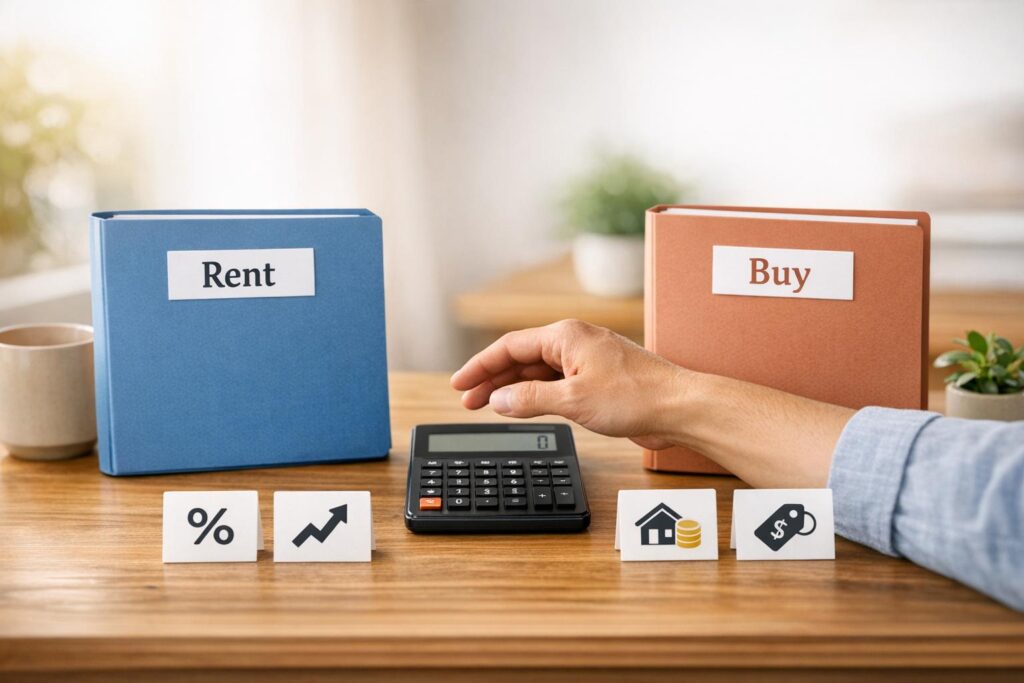
Compare Renting and Buying With More Confidence
A good Rent vs Buy Calculator helps you look past the headline numbers and focus on the full financial picture. Monthly rent is only one side of the equation. Buying a home also includes mortgage payments, property taxes, insurance, HOA dues, maintenance, closing costs, and the value you may recover when you sell.
See the Long-Term Tradeoffs
This tool projects rent increases over time, estimates home appreciation, and calculates remaining mortgage balance using amortization logic. That makes it easier to compare total renting costs with total ownership costs over the years you expect to stay. Instead of guessing, you can review a side-by-side estimate built around your own assumptions.
A Practical Home Decision Tool
Whether you’re a first-time buyer or trying to decide if renewing your lease makes more sense, this rent vs buy calculator keeps the results centered on the decision itself. You’ll see estimated sale proceeds, projected home value, and the financial difference between renting and buying in plain language. If you want a deeper comparison, you can also include an investment return assumption to measure the opportunity cost of using your down payment for a home purchase rather than keeping it invested.
Results are estimates, not financial advice, but they can give you a much clearer starting point.
FAQs
How does this calculator decide whether renting or buying looks better?
It compares the total cost of renting with the total cost of owning over the time period you choose. On the buying side, it includes mortgage payments, property taxes, homeowners insurance, HOA dues, maintenance, upfront closing costs, and estimated selling costs. It also factors in projected home appreciation and the remaining mortgage balance to estimate how much equity you may walk away with if you sell. The result is a scenario-based comparison, not a guaranteed outcome.
Why does the time horizon matter so much in a rent vs buy comparison?
The number of years you expect to stay in the home can change the picture quite a bit. Buying usually comes with large upfront costs, so a shorter stay can make ownership less favorable because there’s less time to build equity and spread out those costs. A longer stay may improve the case for buying if the home appreciates, rent rises, and the mortgage balance falls over time. That’s why it’s smart to test a few different timelines before making a decision.
What does the investment return option show?
This option estimates what might happen if the cash used for the down payment and upfront buying costs stayed invested instead of being put into the home. It gives you a helpful opportunity-cost view, which is often missed in simple calculators. If that invested amount could grow meaningfully over your time horizon, renting may look stronger in some scenarios. If not, buying may still come out ahead. It’s a useful comparison, but it depends heavily on the return rate you assume.