

Dallas is more expensive than Fort Worth, but higher salaries in Dallas help offset some costs. Here’s a quick breakdown:
- Housing: Fort Worth is cheaper, with median home prices about $40,000 lower and rent savings of up to 30% for larger apartments.
- Utilities: Fort Worth costs 4.4% less overall, though internet and mobile plans are pricier.
- Transportation: Fort Worth is more affordable, with lower public transit fares and gas prices.
- Groceries: Fort Worth offers slight savings, with items like eggs and milk costing up to 20% less.
- Entertainment: Dining, movies, and gym memberships are significantly cheaper in Fort Worth, saving up to 30%.
- Healthcare: Dallas has slightly lower costs, but Fort Worth’s property prices may appeal to retirees.
Quick Comparison
| Category | Dallas | Fort Worth | Difference |
|---|---|---|---|
| Median Home Price | $372,500 | $335,000 | ~$40,000 lower in Fort Worth |
| 3-BR Rent (City) | $3,750 | $2,634 | 29.8% lower in Fort Worth |
| Utilities (915 sq ft) | $227.03 | $217.12 | 4.4% lower in Fort Worth |
| Monthly Transit Pass | $126.00 | $78.26 | 38% lower in Fort Worth |
| Dozen Eggs | $4.74 | $3.81 | 19.7% lower in Fort Worth |
| Dinner for Two | $85.00 | $60.00 | 29.4% lower in Fort Worth |
If you’re seeking lower costs, Fort Worth is the better choice for families and remote workers. Dallas, with higher salaries and lower insurance rates, may suit young professionals better. Retirees might prefer Fort Worth for cheaper housing but should weigh Dallas’s lower healthcare costs.
Dallas vs Fort Worth Cost of Living Comparison 2026
Housing Costs in Dallas vs. Fort Worth
Home Purchase Prices
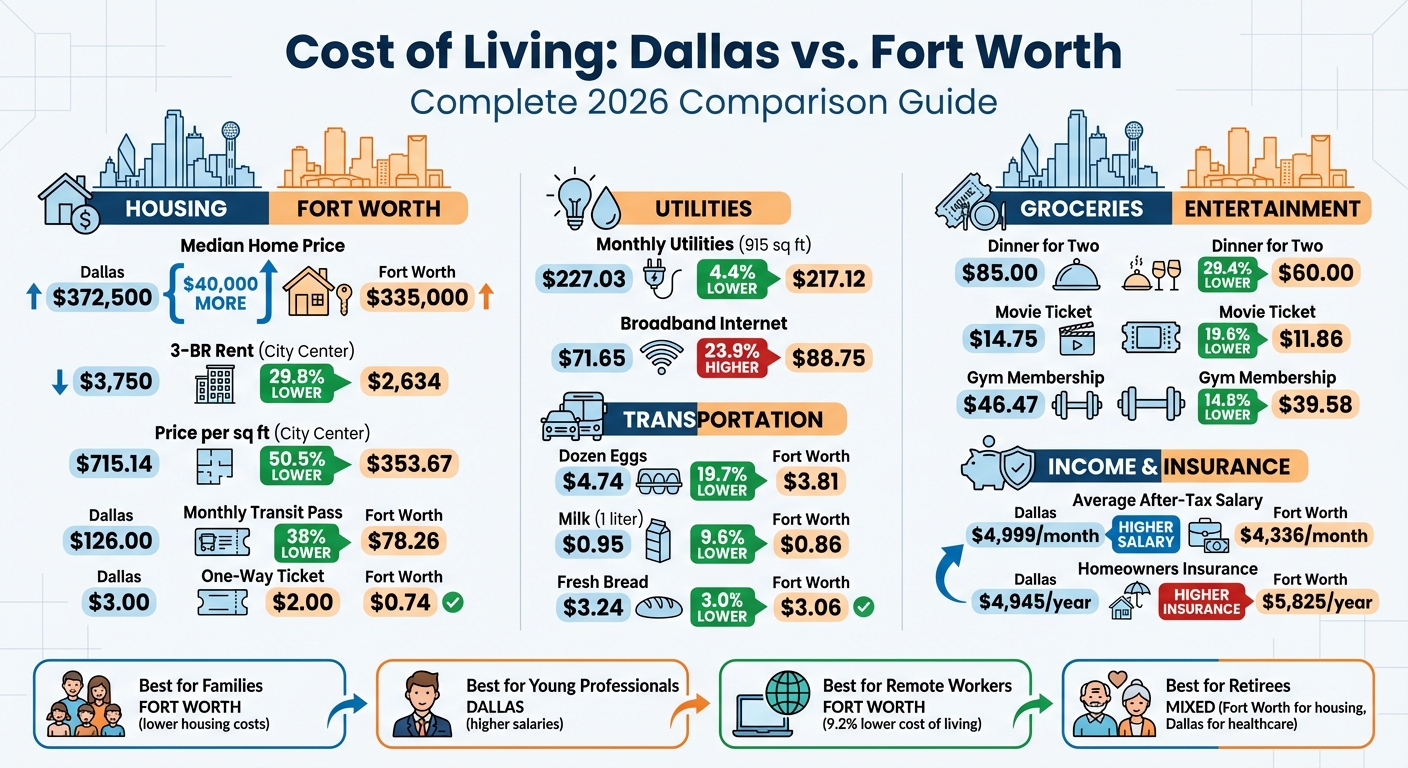
The median home price in Dallas stands at $372,500, while Fort Worth’s is $335,000 – a difference of nearly $40,000. If you’re looking at price per square foot in the city center, Dallas averages $715.14, compared to $353.67 in Fort Worth. That means space in Fort Worth costs 50.5% less.
In December 2025, the median close price in Dallas dropped by 6.25% to $375,000, and active listings increased by 8.97%. According to Marco Santarelli:
It’s a healthy correction.
Homes are also staying on the market longer, now averaging 103 days to sell – a 5.10% increase compared to the previous year.
Rental Prices
Renters in Dallas generally pay more across all apartment types. For example, a one-bedroom apartment in the city center averages $1,766 in Dallas, while the same unit in Fort Worth costs $1,679 – a 4.9% savings. The difference becomes even more pronounced with larger apartments. A three-bedroom unit in Dallas’ city center averages $3,750, compared to $2,634 in Fort Worth.
| Rental Comparison (Feb 2026) | Dallas | Fort Worth | Savings in Fort Worth |
|---|---|---|---|
| 1 BR (City Center) | $1,766 | $1,679 | 4.9% |
| 1 BR (Outside Center) | $1,476 | $1,190 | 19.3% |
| 3 BR (City Center) | $3,750 | $2,634 | 29.8% |
| 3 BR (Outside Center) | $2,593 | $2,157 | 16.8% |
These rental differences highlight unique opportunities for investors in both cities.
Real Estate Investment Options
When it comes to real estate investing, costs play a major role in shaping affordability. Fort Worth’s lower home prices are especially appealing to first-time investors. On the other hand, Dallas offers higher rental premiums, which can generate stronger monthly cash flow despite the steeper initial investment.
For those navigating these markets, Tom’s Texas Realty offers valuable support. Their off-market home options give access to up to three times more listings than traditional MLS platforms. With personalized consultations and a fast mortgage qualification process that doesn’t require a credit pull, they can help you find properties that align with your budget and investment plans.
Utilities and Monthly Expenses in Dallas vs. Fort Worth
Electricity, Water, and Gas Costs
When comparing monthly utility costs, the difference between Dallas and Fort Worth is relatively small. For a typical 915 sq ft apartment, utilities – including electricity, heating, cooling, water, and garbage – average $227.03 in Dallas and $217.12 in Fort Worth, making Fort Worth about 4.4% less expensive.
Breaking it down further:
- Electricity: Costs are about $165 per month in Dallas and $160 in Fort Worth.
- Water: Averages $45 in Dallas versus $42 in Fort Worth.
- Natural Gas: Slightly higher in Fort Worth at $38, compared to $35 in Dallas.
| Utility Component | Dallas | Fort Worth | Difference |
|---|---|---|---|
| Electricity | $165 | $160 | $5 |
| Water | $45 | $42 | $3 |
| Natural Gas | $35 | $38 | -$3 |
| Total (915 sq ft) | $227.03 | $217.12 | $9.91 |
However, communication expenses are noticeably steeper in Fort Worth. Broadband internet averages $71.65 in Dallas, but jumps to $88.75 in Fort Worth – an increase of 23.9%. Similarly, mobile phone plans cost $68.83 in Dallas compared to $89.25 in Fort Worth.
Energy Efficiency and Climate Factors
Both cities experience comparable weather, which directly impacts energy usage. Texas’s deregulated electricity market gives residents the freedom to select from various retail providers.
"With hot summers and cold winters, Dallas experiences seasonal spikes in energy use, leading to higher bills."
Even though Texas electricity rates average 16.04 ¢/kWh, which is about 9.8% lower than the national average of 17.78 ¢/kWh, total energy bills often remain higher. Why? Texans use more energy overall. The average household in Texas consumes 1,146 kWh per month, far surpassing the national average of 863 kWh. This is largely due to the extreme heat and the heavy reliance on air conditioning, which drives up energy consumption and, ultimately, monthly utility costs.
Transportation and Grocery Costs in Dallas vs. Fort Worth
Transportation Costs
When it comes to transportation, Fort Worth is easier on the wallet compared to Dallas. Fort Worth’s transportation index sits at 97, while Dallas scores slightly higher at 101. On average, monthly transportation expenses amount to $190 in Dallas but drop to $137 in Fort Worth – a noticeable difference for commuters.
Public transit costs further highlight the gap. Dallas Area Rapid Transit (DART) charges $3.00 for a one-way ticket and $126.00 for a monthly pass. Meanwhile, Fort Worth’s Trinity Metro offers cheaper fares at $2.00 per ride and $78.26 for a monthly pass – approximately 38% less per month. Even gas prices lean in Fort Worth’s favor, averaging $0.74 per liter compared to $0.76 in Dallas.
| Transportation Item | Dallas | Fort Worth | Difference |
|---|---|---|---|
| One-Way Transit Ticket | $3.00 | $2.00 | 33.3% lower |
| Monthly Transit Pass | $126.00 | $78.26 | 37.9% lower |
| Gasoline (per liter) | $0.76 | $0.74 | 2.6% lower |
Grocery Costs
Grocery shopping also costs slightly less in Fort Worth than in Dallas. The grocery index shows a small advantage for Fort Worth at 93, compared to 94 in Dallas, translating to about 1% lower overall grocery expenses.
A closer look at specific items reveals even more savings. A dozen eggs cost $4.74 in Dallas but only $3.81 in Fort Worth, a 19.7% difference. Similarly, a liter of milk is priced at $0.95 in Dallas versus $0.86 in Fort Worth. Bread follows the trend, with a loaf of fresh white bread costing $3.24 in Dallas and $3.06 in Fort Worth. For households, whether single or family-sized, these differences can lower monthly grocery bills, which typically range between $200 and $300 in the Dallas–Fort Worth region.
| Grocery Item | Dallas | Fort Worth | Difference |
|---|---|---|---|
| Milk (1 liter) | $0.95 | $0.86 | 9.6% lower |
| Eggs (12 large) | $4.74 | $3.81 | 19.7% lower |
| Fresh White Bread (1 lb) | $3.24 | $3.06 | 5.7% lower |
| Chicken Fillets (1 lb) | $6.52 | $6.25 | 4.1% lower |
Healthcare, Lifestyle, and Entertainment Costs
Healthcare Costs
When it comes to healthcare, Fort Worth edges out Dallas with costs that are about 2% lower. That said, healthcare in the region remains expensive, making solid insurance coverage a must. Without insurance, a routine physical exam typically costs $50–$200, while insured residents generally pay co-pays between $10 and $50.
For medical facilities, Dallas is home to renowned institutions like Baylor University Medical Center and UT Southwestern, while Fort Worth features Texas Health Harris Methodist Hospital. However, homeowners in Fort Worth face higher insurance costs, averaging $5,825 annually, compared to $4,945 in Dallas.
Beyond healthcare, the two cities also differ in how much it costs to enjoy daily leisure and entertainment.
Entertainment and Leisure Options
Fort Worth stands out for its lower entertainment and dining costs compared to Dallas. For instance, dining out at a mid-range restaurant is significantly cheaper. A three-course meal for two costs $85.00 in Dallas but drops to $60.00 in Fort Worth, saving you a hefty 29.4%. Even smaller outings like a movie night are more affordable, with tickets priced at $11.86 in Fort Worth versus $14.75 in Dallas – a 19.6% difference. Gym memberships follow the same trend, costing $39.58 per month in Fort Worth compared to $46.47 in Dallas, a 14.8% savings.
Cultural attractions also vary. Fort Worth offers free admission to the Amon Carter Museum and Kimbell Art Museum, while the Dallas Museum of Art provides free access to over 24,000 works. For paid attractions, Fort Worth Zoo tickets are $16 per adult, while Dallas World Aquarium admission is higher at $26.95. Sports fans in Dallas can catch Mavericks games for as little as $15, while Cowboys tickets in Arlington range from $41 to $148.
| Category | Dallas | Fort Worth | Difference |
|---|---|---|---|
| Mid-Range Dinner for Two | $85.00 | $60.00 | 29.4% lower |
| Movie Ticket | $14.75 | $11.86 | 19.6% lower |
| Monthly Gym Membership | $46.47 | $39.58 | 14.8% lower |
sbb-itb-9bb2e84
The REAL Cost of Living in Dallas–Fort Worth (2025 Edition)
Which City Fits Your Budget: Dallas or Fort Worth
Looking at housing, utilities, and everyday expenses, Dallas and Fort Worth each cater to different lifestyles and budgets. Fort Worth stands out for families and remote workers seeking lower costs, while Dallas offers better opportunities for young professionals due to higher salaries. When factoring in rent, Fort Worth’s cost of living is about 9.2% lower, with housing costs approximately 20.1% cheaper than in Dallas.
For families, Fort Worth provides a noticeable edge. As mentioned earlier, three-bedroom homes and median home prices are significantly more affordable, making it easier to find family-sized housing that fits the budget.
Young professionals may find Dallas more appealing. With net salaries about 10.6% higher ($4,665.77 in Dallas versus $4,170.66 in Fort Worth), the increased earnings help offset higher rent and transportation expenses.
Remote workers can benefit from Fort Worth’s lower overall living costs and the availability of larger homes, which are ideal for setting up a home office. However, broadband internet costs are higher in Fort Worth, as noted in the utilities comparison.
Retirees face a more nuanced decision. Fort Worth offers lower property prices – around $174.47 per square foot outside the city center compared to $268.71 in Dallas. However, Dallas has lower homeowners insurance costs (roughly $4,945 annually versus $5,825 in Fort Worth) and healthcare costs about 6% lower, which are critical considerations for those on fixed incomes.
Here’s a quick breakdown of how each city aligns with different lifestyles:
| Group | Best Choice | Key Advantage | Main Trade-Off |
|---|---|---|---|
| Families | Fort Worth | Three-bedroom homes can cost over $100K less | Childcare and utility costs are comparable |
| Young Professionals | Dallas | Higher net salaries (about 10.6% more) | Rent and transportation are roughly 20% higher |
| Remote Workers | Fort Worth | Living costs are about 9.2% lower | Broadband costs are nearly 24% higher |
| Retirees | Fort Worth (Housing) / Dallas (Healthcare) | Fort Worth has lower property prices (~$174/sq ft vs. ~$268/sq ft) | Dallas offers lower healthcare and insurance costs |
If you’re exploring the Dallas–Fort Worth area, Tom’s Texas Realty can guide you to the right choice for your lifestyle and budget. With expertise in both cities, they offer access to exclusive off-market homes – about three times more than traditional MLS listings – along with free mortgage qualification and personalized consultations.
Conclusion
When it comes to balancing lifestyle affordability with income potential, Fort Worth stands out for its lower living costs, including housing, transportation, and rent. On the other hand, Dallas offsets its higher expenses with greater after-tax incomes and lower homeowners insurance rates. Fort Worth’s cost of living, including rent, is about 9.2% lower than Dallas, making it a practical choice for families and remote workers looking to save on monthly expenses. Meanwhile, Dallas offers higher average after-tax salaries at $4,999 per month compared to Fort Worth’s $4,336, which can help manage its steeper costs. For retirees, the choice often comes down to Fort Worth’s affordability versus Dallas’s lower annual homeowners insurance costs of $4,945 compared to Fort Worth’s $5,825.
In summary, Dallas brings higher earnings and cheaper insurance to the table, while Fort Worth offers lower living costs across most categories. Families may find Fort Worth’s housing options more appealing, and remote workers can benefit from reduced monthly expenses, even if broadband costs are higher.
If you’re considering a move, Tom’s Texas Realty can guide you with local expertise in both cities. They provide access to exclusive off-market properties and personalized consultations to help you find a home that fits your budget and lifestyle. Whether you’re drawn to Dallas’s vibrant city life or Fort Worth’s more affordable charm, this analysis can help you make an informed decision.
FAQs
How does the cost of living compare between Dallas and Fort Worth?
The cost of living in Fort Worth tends to be easier on the wallet compared to Dallas, with housing being the standout factor. On average, rent in Fort Worth is about 17.5% cheaper than in Dallas, and overall housing expenses follow the same trend. Additionally, utilities and transportation costs are slightly lower in Fort Worth, making it a more budget-conscious choice.
Dallas, on the other hand, offers a vibrant urban lifestyle packed with amenities. But Fort Worth’s more affordable and laid-back atmosphere appeals to those wanting to cut down on daily expenses while still enjoying the benefits of living in the Dallas-Fort Worth area.
Are salaries higher in Dallas or Fort Worth?
On average, salaries in Dallas tend to be a bit higher than in Fort Worth. Workers in Dallas earn around 1.3% more, with the average annual salary sitting at $60,807, compared to $60,000 in Fort Worth. While the gap isn’t huge, it could still play a role in your decision, especially when considering your career and financial objectives.
Which city is better for real estate investment: Dallas or Fort Worth?
Dallas boasts a lively real estate market with strong potential for property value growth. The average home price here sits at $468,187, highlighting the high demand fueled by its bustling urban setting. With thriving business hubs, ongoing development, and competitive salaries, Dallas appeals to investors looking for growth and substantial long-term returns.
In contrast, Fort Worth offers a more affordable entry into the market, making it a solid choice for first-time investors or those prioritizing consistent rental income. Known for its historic charm and suburban vibe, Fort Worth attracts a different crowd, providing a more cautious investment route with lower costs.
In short, Dallas caters to investors seeking high-growth opportunities in a competitive market, while Fort Worth presents a cost-effective and steadier path.